Wednesday, June 1, 2011

A Believer's "Coming Out"


Photo courtesy of http://www.mamamia.com/

I have had a few conversations with believers lately that have brought the concept of blind faith to the fore. I am proud to say that I don't believe in a god. Sure, at times it can be a bit awkward to say when I know I am in the presence of believers whose relationship with me I value. But I am always very proud to declare my non-belief. It is a core element of who I am on par with my gender identity, nationality, sexual orientation, and being a fan of Arsenal FC.

While believers and I will likely never see eye to eye on anything to do with our chosen paths of belief, I would assume we both share one thing in common: a pride in the belief system we have chosen. I have to assume that the sense of identification I have in stating "I cannot believe in a god because I don't believe in blind faith" is mirrored by a believer stating "I have blind faith in God because I think some things are 'bigger' than science." In fact, I will even say that I "get" the latter statement. While I know I could never accept blind faith personally, I do respect that many people feel it.

So where am I going here? Well my aforementioned conversations have revealed several believers who appear to be "in the closet" with their blind faith. While they clearly declare their belief in "God" they become hesitant to base this belief on faith. When I say, "I respect your decision to believe in god I just can't have blind faith in something," they respond with a statement indicating that their belief in "God" is based on something more empirical than faith. It's at this point that my "New Atheist" side is revealed.

I don't claim to know for sure that there is no god. I claim that, based on all of the objective, measurable, falsifiable information available to me, I believe there is a near absolute improbability that a god exists. My lack of belief is based on my need for objective proof and I am proud to say it. When a believer states that: a. They are certain of god's existence and b. That their belief is based on the existence of proof......proof in the form of miracles, I lose my cool.

I'll end this with some semantics. "Faith" refers to the concept of hope and belief in something and it is a word with a broad range of utility. For example, I have faith that my wife and I will do our best to raise our daughter to be a responsible and considerate adult. I have no internal conflict when I make a statement like this. This "faith" is based on observable and reproducible behaviours that my wife and I plan to use in our parenting. What I cannot control are my daughter's genes, what may happen to her parent's health, what happens to the earth during her lifetime etc. I have no faith in those things because they are beyond any one's control and my psychological make up just does not allow me to have faith in these types of things. This is how I would characterize religious faith or "blind faith." It is a trust in the truth of of an unproven deity, the questionable history of a messiah, the future return of this messiah, and the existence of an afterlife. None of which has any objective, reproducible evidence or tangible probability of happening based on trends to date. As such, any one believing this is putting faith in something far different than putting faith in a sports team, family member, or friend. This is what I, and I will confidently predict most people, mean when they use the phrase "blind faith." While I don't have the ability to have blind faith I certainly appreciate its attraction and would fight for people's right to it. I just wish those whose belief depends on blind faith were as proud of it as I am of not having any.
- Posted using BlogPress from my iPad


Monday, May 23, 2011

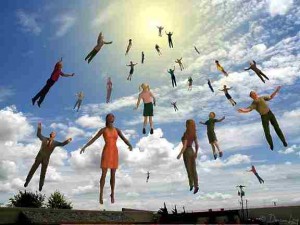
Who's More Crazy? A Post (non) Rapture Reflection.

Photo courtesy of www.finkorswim.com
I know we are all sick of hearing about Harold Camping's rapture predictions. So I will attempt to make my point in as few words as possible.

Here is the question that the rapture media frenzy has left me with: What makes Mr. Camping all that more crazy than all the "normal" believers out there? Over the past three weeks I have observed so many believers, primarily those that we would call "moderate Christians",  exclaiming their opinion that Camping is a nut-job; that predicting the date and time of the rapture and posting it on billboards across the continent gives all Christians a bad name.

It's as if we have all forgotten about the subject of Mr. Camping's prediction and the one thing that his fellow Christian naysayers generally have no problem with: the return of a dead man, said to be the son of God and a virgin ,sent  to bring all of his followers into heaven while leaving us non-believers to suffer and  die in his created earthquakes followed by an eternity of  suffering in hell. Sure Christians of varying sects and degrees of belief may have variations on this story but the essence is the same: that Jesus will return from the dead, rapture his believers, leaving the non-believers to struggle in hell with Satan.

But what element of Mr. Camping's proclamation do believers feel most tarnishes their own Christian beliefs? May 21, 2011. 6pm. A date. A time.

I don't know, call me crazy, I have a harder time with the rapture part.

Tuesday, May 17, 2011

A pre May 21 Question

Okay, so let's play make-believe and say the predictions of the May 21 rapture are true. How many of you think that Jesus will accept into his eternal kingdom, atheists who have treated their fellow man and planet with deserved respect?

And before you proclaim that I am worried, I leave you with this: send me to hell if you must Jesus, because I still don't believe in your heavenly father.

Come on people, leave some comments on this one. It's not very often you are faced with a rapture.

Friday, April 29, 2011

Keeping It Simple on a Day of Extravagance.

While Will and Kate push this day over the top, I figured it would be a nice foil to go back to basics. This is what being Atheist means to me.

I don't believe there are any supernatural gods. I don't know that there aren't any supernatural gods but my commitment to applying logic to what I believe leads me to a conclusion that there is a much stronger probability of the inexistence of gods than the existence of gods. I am not afraid of being wrong and hence don't feel compelled to close my mind to the possibility (albeit incredibly unlikely) that a god exists. What makes me, and I suggest all non-theists, different than believers is that the foundation of my non-belief is based on that which is objectively probable, while their belief is based on a faith with no objective probability. This is not a judgement statement, just an indisputable observation.

Simple as that. My deeper value set and how I choose to treat the world and its creatures doesn't come from my lack of theism just like a theist's approach to life doesn't stem from his or her non-belief in the thousands of gods outside of their chosen faith. How shallow would that be? My chosen life approach comes from an innate desire to treat my world with deserved respect. An inherent feeling that it is just "right" to do good. Call it humanism if you must label it.

That's it. If this sounds like you, embrace it openly.

Enjoy the wedding and congrats William and Kate. You seem lovely.